Car Maintenance Checklist by Kilometre: What to Replace and When
Last updated: 29 Oct 2026
7 Views
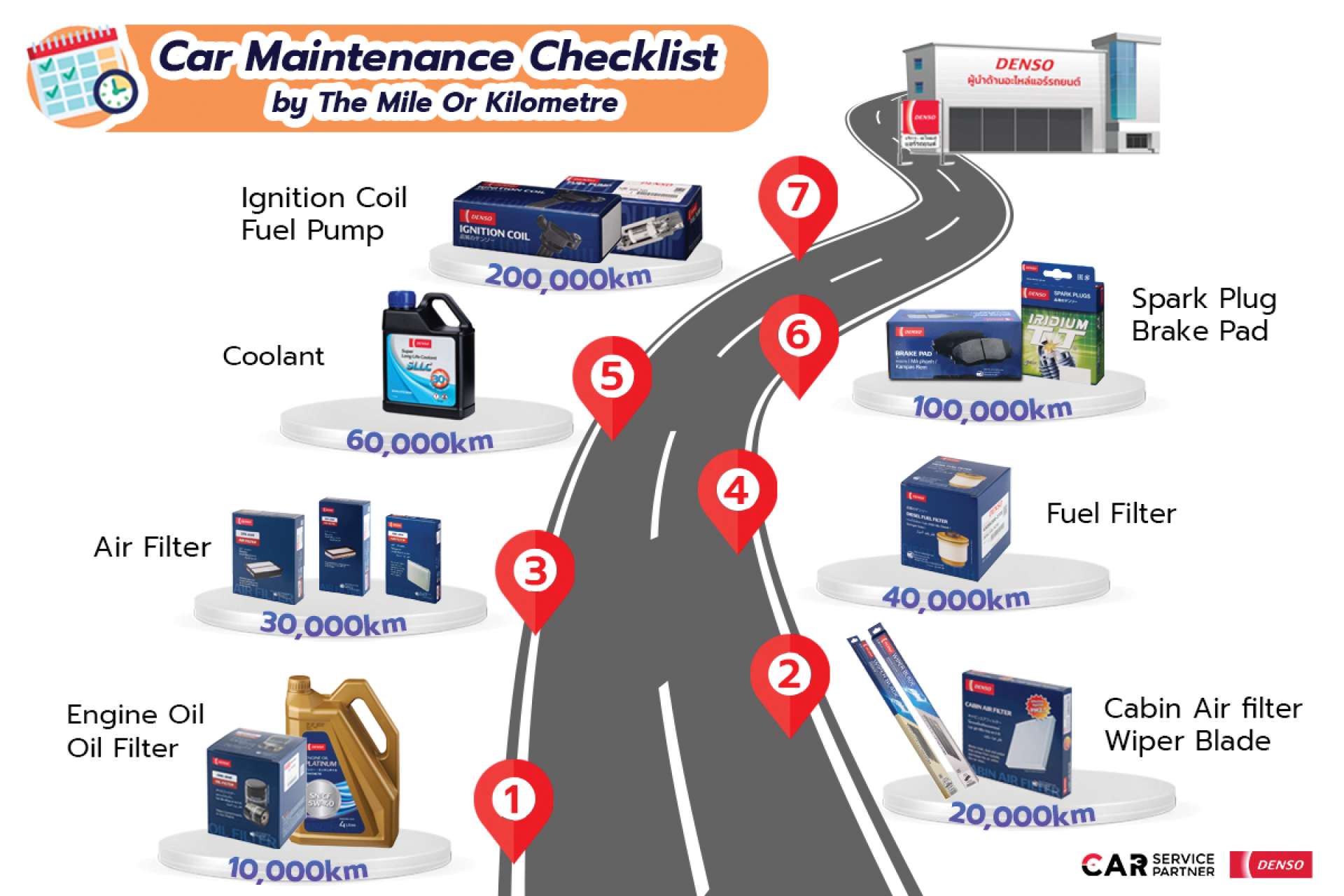
A regular Car Maintenance Checklist is one of the easiest ways to keep a vehicle reliable, safe, and comfortable to drive. Instead of waiting until a problem occurs, vehicle owners can use mileage as a practical reminder to inspect and replace important maintenance parts.
This Car Maintenance Checklist provides a simple guide for common replacement intervals, from engine oil and filters at 10,000 km to ignition coils and fuel pumps at higher mileage. Following a Car Maintenance Checklist can also help drivers identify worn components before they affect vehicle performance.
Maintenance requirements can vary depending on vehicle model, engine type, driving conditions, and manufacturer recommendations. Therefore, the kilometre intervals below should be used as a general Car Maintenance Checklist, together with the vehicle owner's manual and professional inspection.
Why Is a Car Maintenance Checklist Important?
A Car Maintenance Checklist helps vehicle owners understand what parts should be inspected as mileage increases. Regular maintenance can help maintain vehicle performance, support fuel efficiency, improve driving comfort, and reduce the risk of unexpected problems.
For example, engine oil naturally deteriorates during operation, filters collect dirt and contaminants, wiper blades become worn, and brake components gradually wear through normal driving.
Using a Car Maintenance Checklist makes maintenance easier to plan. Instead of checking components randomly, vehicle owners can organize maintenance according to mileage and actual component condition.
Car Maintenance Checklist at 10,000 km
The first important point in the Car Maintenance Checklist is around 10,000 km.
Engine Oil and Oil Filter
Engine oil plays an essential role in lubricating moving engine components and reducing friction. Over time, engine oil can deteriorate and become contaminated.
The oil filter also captures contaminants circulating through the lubrication system. Therefore, checking and replacing the engine oil and oil filter at the recommended interval is an important part of every Car Maintenance Checklist.
The correct engine oil specification and replacement interval should always follow the recommendations for the specific vehicle.
Car Maintenance Checklist at 20,000 km
At approximately 20,000 km, drivers should pay additional attention to visibility and cabin comfort.
Cabin Air Filter
The cabin air filter helps prevent dust and other airborne particles from entering the vehicle's passenger compartment through the air-conditioning and ventilation system.
A dirty cabin air filter may reduce airflow from the air-conditioning system. The actual replacement period can vary depending on environmental conditions, particularly when driving frequently in dusty areas or heavy traffic.
Wiper Blades
Clear visibility is essential for safe driving, especially during Indonesia's rainy season. Wiper blades should therefore be inspected regularly for cracks, deterioration, streaking, or reduced wiping performance.
Adding wiper blade inspection to the Car Maintenance Checklist can help drivers maintain better visibility when driving in rain.
Car Maintenance Checklist at 30,000 km
At 30,000 km, the Car Maintenance Checklist moves to another component that supports engine performance.
Air Filter
The engine air filter helps prevent dust and contaminants from entering the engine. When the air filter becomes excessively dirty, airflow can be restricted.
Vehicle owners should inspect the air filter periodically and replace it according to vehicle manufacturer recommendations and actual driving conditions. Cars frequently operated in dusty environments may require more frequent inspection.
Car Maintenance Checklist at 40,000 km
The next point on the Car Maintenance Checklist is approximately 40,000 km.
Fuel Filter
The fuel filter helps prevent unwanted particles and contaminants in the fuel system from reaching sensitive components.
Fuel-filter design and maintenance intervals can differ considerably between gasoline and diesel vehicles. For this reason, the 40,000 km interval should be considered a general reference. Drivers should always check the maintenance schedule specified by the vehicle manufacturer.
Car Maintenance Checklist at 60,000 km
At around 60,000 km, coolant should receive additional attention.
Engine Coolant
Coolant helps manage engine operating temperature and protects the cooling system. Over time, coolant quality may deteriorate and its protective properties may decrease.
Checking coolant level and condition should therefore be included in a regular Car Maintenance Checklist.
Only coolant that meets the specification recommended for the vehicle should be used. Mixing incompatible coolant types should be avoided.
Car Maintenance Checklist at 100,000 km
As a vehicle reaches higher mileage, several important components should receive closer inspection.
Spark Plugs
Spark plugs are important components in gasoline engines because spark plugs create the spark required for combustion.
Worn spark plugs can affect starting and engine operation. Spark plug life varies significantly depending on the spark plug type, engine design, and operating conditions. Long-life iridium spark plugs, for example, may have different maintenance intervals from conventional spark plugs.
Brake Pads
Brake pads are essential safety components and should never be replaced solely according to mileage.
Driving environment, vehicle load, traffic conditions, driving habits, and braking frequency can all affect brake pad wear. Brake-system inspection should therefore be included regularly in the Car Maintenance Checklist, even before the vehicle reaches 100,000 km.
If unusual brake noise, vibration, reduced braking performance, or other abnormalities occur, the brake system should be inspected promptly by a qualified technician.
Car Maintenance Checklist at 200,000 km
At very high mileage, attention should be given to components that are generally designed for long service life.
Ignition Coil
The ignition coil provides the high voltage required by the spark plugs. Unlike engine oil or filters, ignition coils are generally not treated as routine replacement items based only on mileage.
At higher mileage, technicians can inspect ignition-system performance and diagnose an ignition coil if symptoms such as misfiring or unstable engine operation occur.
Fuel Pump
The fuel pump delivers fuel from the tank to the engine at the required pressure and flow.
Fuel pumps are also normally inspected according to their condition rather than automatically replaced at a specific mileage. If the vehicle experiences starting problems, loss of power, abnormal fuel pressure, or other fuel-system symptoms, professional diagnosis should be carried out before replacing components.
Your Car Maintenance Checklist Can Vary
Although mileage provides a useful maintenance reference, every vehicle is different. A Car Maintenance Checklist should take several factors into consideration:
Vehicle manufacturer and model
Age and mileage of the vehicle
Gasoline or diesel engine
Driving frequency
Urban or highway driving
Dusty or demanding environments
Heavy traffic and frequent stop-and-go driving
Vehicle manufacturer's recommended maintenance schedule
This is why professional inspection remains important. A technician can check the actual condition of vehicle components and recommend maintenance according to the vehicle's requirements.
Follow a Car Maintenance Checklist for Better Vehicle Care
Preventive maintenance does not need to be complicated. A clear Car Maintenance Checklist gives vehicle owners a useful starting point for understanding when essential components should be inspected.
Remember these general milestones:
10,000 km: Engine oil and oil filter
20,000 km: Cabin air filter and wiper blades
30,000 km: Air filter
40,000 km: Fuel filter
60,000 km: Coolant
100,000 km: Spark plugs and brake pads
200,000 km: Ignition coil and fuel pump
These intervals are general references rather than universal replacement requirements. Always follow the maintenance schedule specified by the vehicle manufacturer and consult a qualified technician when necessary.
For professional vehicle inspection, maintenance advice, and quality automotive parts, visit a DENSO Service Dealer or Car Service Partner in your area.
Related Content
Key reasons for your car’s air conditioning are important
14 Jul 2026
